- No products in the cart.


10
Nov
Wedding Rings Melbourne: Which Hand and Finger Do you Wear Your Wedding Ring on?
It’s the question we are often asked at our Collins Street store, by couples choosing their wedding rings in Melbourne. Which hand does your wedding ring actually go on? And how do you wear it? The honest answer is that it depends on the culture you and your partner are from, what you believe and which traditions you choose to carry with you.
The wedding ring is one of the oldest and most romantic traditions we still follow today.
Here’s a guide through the rituals and traditions of wedding rings, why they are worn in certain ways, the romance and the surprisingly strong opinions behind one very small circle of gold.
Where Wedding Rings Began: An Endless Circle
Before we explain how a wedding ring is worn, it helps to know where the tradition of the wedding ring first began. Wedding rings can be traced all the way back to Ancient Egypt, roughly 4,800 years ago. Early rings were often simple bands braided from reeds, hemp or leather, rather than the precious metals and diamonds we are familiar with today.
The circular shape carried tremendous meaning. A circle has no beginning and no end, which makes it a natural symbol of eternity and eternal love. To the Egyptians, giving a ring meant offering a love that would last forever. Over the centuries, the humble woven band gave way to ivory, bone and metal, today with gold, platinum and diamonds. But the meaning never changed: love that has no end.
Why is the Wedding Ring Worn on the Left Hand? The “Vein of Love”
The meaning and tradition behind wearing a wedding ring on the fourth finger on the left hand derives from the Ancient Romans. They believed a vein ran straight from the fourth finger of the left hand to the heart. They called it the vena amoris, the vein of love. Modern anatomy and science has long since disproven the idea, yet the legend was too romantic to let go, and it has survived to this day.
Roman rings were often made of iron, a metal associated with strength and permanence, and later of gold. A ring was both a pledge and a promise, a visible sign that two people had made a commitment to one another and a public showcase of their devotion.
This is the reason the wedding ring, and the engagement ring too, is traditionally worn on the left hand in Australia, the United Kingdom, the United States and much of the Western world up until this day.
Medieval Wedding Rings, Vows and the Holy Trinity
As Christianity spread through Europe, wearing and placement of the wedding ring during the ceremony also found a ritual. In medieval England, the groom would place the ring on the bride’s thumb, then her index finger, then her middle finger, naming the Father, the Son and the Holy Spirit, before finally resting it on the fourth finger with the word “Amen”. That last finger became the home of the wedding ring, and the tradition endures.
Victorian Era of Romance: Sentimental Details
The Victorians turned jewellery into a language of feeling. Royal families influenced wedding ring designs by making them deeply personal and fashionable. Wedding rings in this era were designed with symbols that carried meaning, from details such as hearts and flowers. This is where much of our modern sense of the wedding ring as something deeply sentimental comes from. A ring was no longer purely a contract, it was a keepsake.
Which Hand Do you Wear Your Wedding Ring on? Right Hand Traditions Around The World
While the left hand is the tradition in Australia, the United Kingdom and the United States, many cultures do things differently. In Russia and Greece, wedding rings are traditionally worn on the right hand, a custom rooted in Orthodox Christian tradition. Poland, Germany and Austria also commonly follow the right-hand custom.
In these cultures, the right hand has long been associated with honour, good faith and oaths, which makes it a fitting place for a vow of a lifetime of devotion and commitment.
Many couples from these cultures choose to wear the wedding ring on the right hand. A deeply meaningful way to wear their forever rings.
See more: Wedding Band FAQS
Wedding Ring and Jewellery Traditions Across Cultures
Around the world, wedding jewellery carries different meanings.
Chinese weddings: Gold carries deep significance as a symbol of prosperity and good fortune, and brides often receive gold jewellery alongside Western-style rings.
Hindu weddings: The exchange of rings is often a modern addition to older customs. Traditional marital jewellery includes necklaces, and married women in many regions wear toe rings.
Muslim weddings: A gift from the groom to the bride, is central to the marriage contract, and many couples also choose to exchange rings as a modern tradition.
Jewish weddings: In a traditional ceremony, the groom places the ring on the bride’s right index finger, and many brides move it to the left ring finger afterwards. The ring is traditionally a plain band without stones.
Customs widely vary within every culture and family traditions are deeply personal. It is about incorporating the most meaningful things to you.
How to Wear with your Engagement Ring: Why the Wedding Ring Sits Closest to the Heart
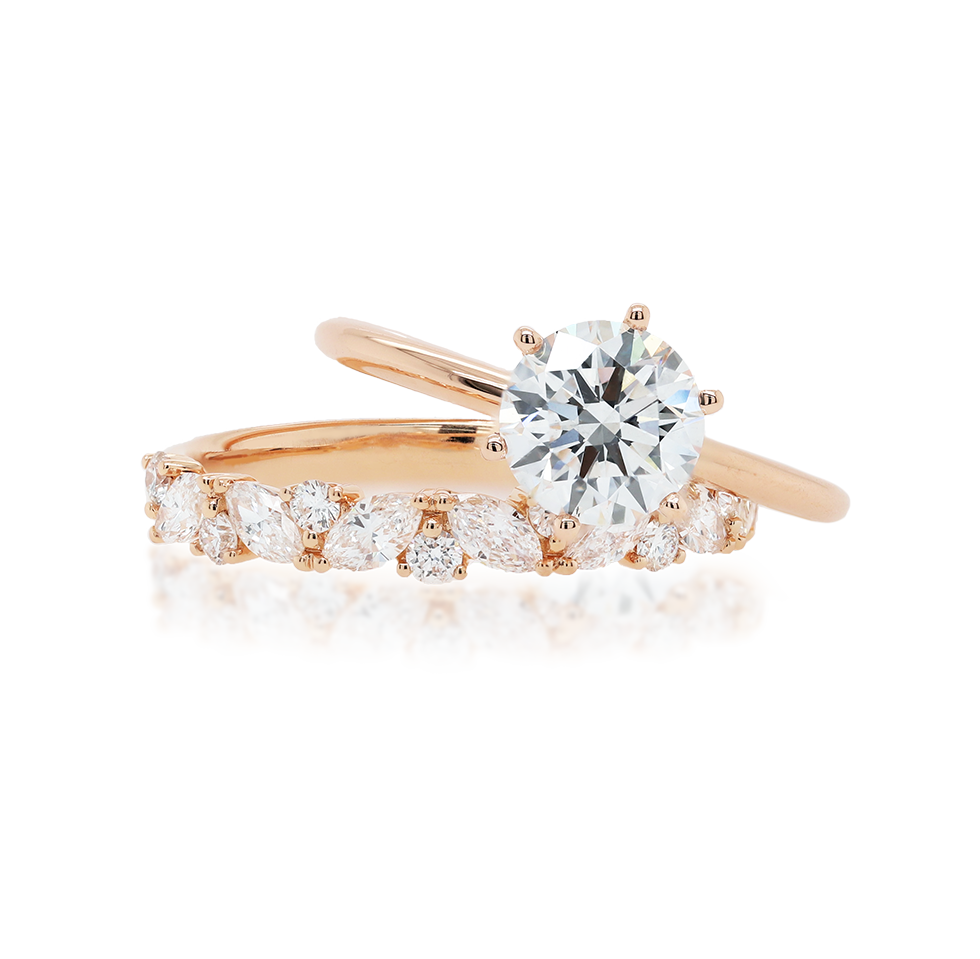
In Western tradition, the wedding ring is worn beneath the engagement ring with the engagement ring placed on top. This comes from the same ancient Roman belief in the vein of love, and having your wedding ring sitting closest to your heart.
Many couples later add an eternity ring above the engagement ring, a band of diamonds that completes the set. Often given as an anniversary gift or to mark a special memory, it carries forward the oldest symbol of all: the unbroken circle.
After the wedding, many couples can choose to wear their wedding rings in their own ways. It may be worn solo, as a set with the engagement ring, or stacking them with multiple rings on the same finger for a unique and layered look.
After marriage, many ladies dream of having an eternity ring to sit above the engagement ring to complete a full set. An eternity ring is given most commonly as a wedding anniversary present or to symbolise a special date and memory between the two of you.
Custom Wedding Rings in Melbourne at JANAI
At JANAI our wedding rings are made to order to honour what matters most to you, your partner and the traditions of your cultures and families. Our team will guide you through metals, band withs, styles, diamonds and fit so your rings are designed for you forever. The wedding rings are custom to your finger size, worn to follow the customs most meaningful to you.
Create your Wedding Ring in Melbourne
Book a private consultation and visit us at our Collins Street store to begin crafting your dream wedding rings in Melbourne.